Bowen Cui† · Weijie Wang†,* · Zeyu Zhang · Yefei He · Mingda Lin · Haoyu Zhao · Yuanyu He · Donny Y. Chen · Feng Chen* · Bohan Zhuang
Paper | Project Page | Code
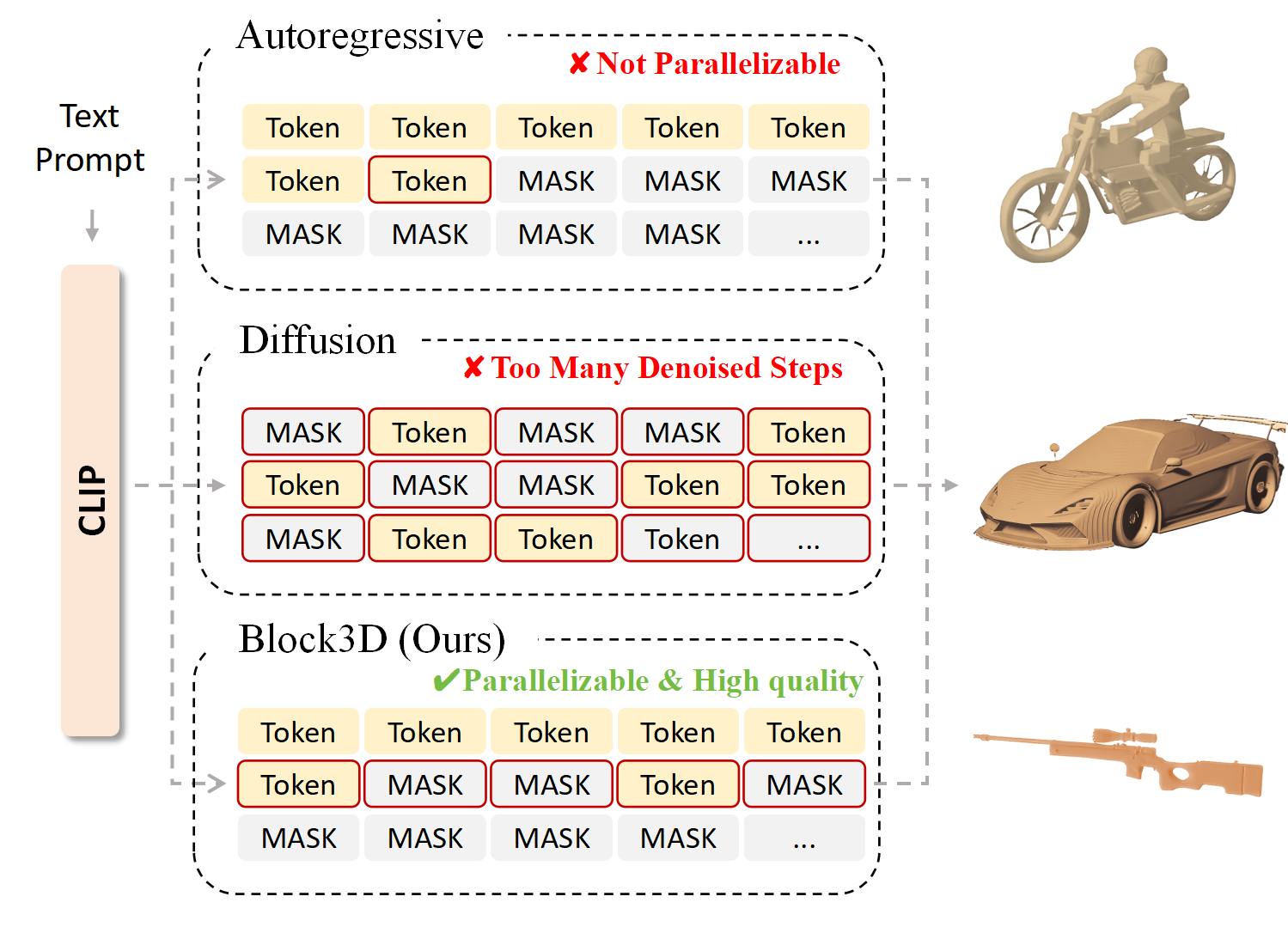
Block3D is an efficient text-to-3D generation framework that shifts the causal dependency of discrete shape tokens from individual tokens to contiguous blocks. It generates one block at a time, denoises all tokens in the active block in parallel, and permits bounded token correction before a block is committed. This preserves causal structure while substantially reducing generation latency.
- 2026-08-24 Update: Release the training, inference, and evaluation code for Block3D.

Given a text prompt, frozen Cube shape and text encoders produce the condition sequence. Block3D then generates the fixed-length discrete shape sequence from left to right in contiguous blocks. Mask-to-token recovery and token-to-token correction jointly update the active block, after which the block is committed and cached. The frozen Cube shape decoder converts the completed sequence into the output mesh.
The reference environment is Linux with Python 3.10+, PyTorch 2.2+, and CUDA. Four NVIDIA A100 80GB GPUs are used for the reported training runs.
python -m venv .venv
source .venv/bin/activate
python -m pip install --upgrade pip
python -m pip install -e .
pymeshlab is optional. Blender is only needed for mesh formats that cannot be
loaded directly by trimesh. PyTorch3D is required by the eight-view CLIPScore
evaluation command.
Training uses the TRELLIS-500K paired text-mesh data. Data are not included. Restore the source records with the following layout:
data/trellis500k_train/
  source_manifest.jsonl
  pairs/
  objaverse_xl_github/
  objaverse_xl_sketchfab/
  abo/
Each pair record contains shape_ids, bbox_xyz, text_input_ids, and
text_attention_mask. The fixed 100-object evaluation definition is included
as benchmark_manifest.jsonl.
The reported runs use a 300K training split after excluding the fixed 100-object evaluation set:
python scripts/prepare_block_diffusion_eval_split.py \
  --dataset-root data/trellis500k_train \
  --source-manifest-path data/trellis500k_train/source_manifest.jsonl \
  --eval-manifest-path benchmark_manifest.jsonl \
  --output-dir data/splits \
  --train-count 300000 \
  --val-ratio 0 \
--seed 42torchrun --standalone --nproc_per_node=4 \
-m block3d.train_block_diffusion \
--train-config-path block3d/configs/train_block3d.yamltorchrun --standalone --nproc_per_node=4 \
-m block3d.train_block_diffusion \
--train-config-path block3d/configs/train_block3d_m2t_only.yamlBoth runs use 35K optimizer steps, global batch size 40, bfloat16 precision,
seed 42, AdamW, and learning rate 1e-4. The final generator checkpoint is
written to runs/<run>/checkpoints/gpt_final.safetensors.
The block-size and denoising-step ablation configurations can be materialized with:
python scripts/materialize_ablation_configs.pypython -m block3d.generate \
--config-path block3d/configs/block3d.yaml \
--gpt-ckpt-path runs/block3d/checkpoints/gpt_final.safetensors \
--shape-ckpt-path model_weights/shape_tokenizer.safetensors \
--prompt "a wooden chair" \
--output-dir outputs/chair \
--num-diffusion-steps 4 \
--guidance-scale 3.0 \
--sampling-strategy block3d \
--disable-postprocessingThe output mesh is outputs/chair/output.obj. The reported text-only protocol
does not pass --bounding-box-xyz. Batch-generation orchestration is not part
of this release.
Create outputs/eval100/samples.jsonl with one record per generated mesh:
{"sample_id":"0000","prompt_text":"...","reference_mesh_path":"...","generated_mesh_path":"0000/generated.obj","bbox_xyz":[0.96,0.90,1.92],"status":"ok"}Run geometry metrics and the eight-view CLIPScore:
python scripts/evaluate_generation.py \
  --run block3d=outputs/eval100 \
  --output-dir outputs/eval100_metrics \
  --surface-samples 8192 \
  --fscore-threshold-pct 0.01 \
  --fscore-threshold-pct 0.02 \
  --seed 0 \
  --clipscore \
  --clip-model model_weights/clip-vit-large-patch14 \
  --clip-render-nviews 8 \
  --clip-render-resolution 512 \
  --clip-render-backend pytorch3d
The evaluator writes samples.jsonl, samples.csv, and summary.json. It
centers and isotropically normalizes each mesh, samples 8,192 surface points,
and uses eight neutral-gray views for CLIPScore.
Reported values on the fixed 100-object evaluation set:
| Variant | CD-L1 | NC | F@1% | F@2% |
|---|---|---|---|---|
| M2T only | 0.0813 | 0.6664 | 0.2872 | 0.5403 |
| M2T + T2T | 0.0775 | 0.6676 | 0.3088 | 0.5507 |
The complete Block3D model reports 4.99 s mean end-to-end latency on one A100 80GB GPU, including text encoding, token generation, and mesh decoding.
If you find this work useful, please consider citing:
@article{cui2026block3d,
  title   = {Block3D: Efficient Text-to-3D Generation via Block-Wise Diffusion},
  author  = {Cui, Bowen and Wang, Weijie and Zhang, Zeyu and He, Yefei and
             Lin, Mingda and Zhao, Haoyu and He, Yuanyu and Chen, Donny Y. and
             Chen, Feng and Zhuang, Bohan},
  journal = {arXiv preprint arXiv:2608.19567},
  year    = {2026}
}Please use the issue tracker of this repository for questions, bug reports, or reproduction issues.
This project builds on the released Cube shape tokenizer, decoder, and GPT backbone, and uses TRELLIS-500K and LLaDA2.1 as described in the paper. We thank the original authors for making their work available.
This project is distributed under the Research-Only RAIL-MS terms preserved in
LICENSE. Block3D is a derivative work based on Cube3D-v0.1 and its released
weights; please review the license before use.