
Qualitative coding that codes what it's sure of, refuses the rest, and proves both.
For researchers who need a κ they can put in a paper, not a number they have to apologise for.
16% is the worked example in this repository. The benchmark against published corpora has not been run yet.





Get started · The evidence · What you get · Methodology · Privacy · Limitations
Hand-coding a corpus against a codebook takes months, and a defensible result needs two coders doing it independently. Pointing a general-purpose LLM at the problem lands around κ = 0.57 against a κ ≥ 0.70 publication bar, so the output is not defensible, and the field has said so in print.
Overall accuracy is the wrong target. A coder that is 57%-reliable overall is not uniformly 57%-reliable: it is near-perfect on obvious items and poor on ambiguous ones. Accuracy on the subset you can identify in advance is the right target, and calibrated probabilities are what let you identify it.
So scruple codes the part it can defend, refuses the rest, and reports the reliability of what it hands back, measured against blind human coding, on data it never fitted to.
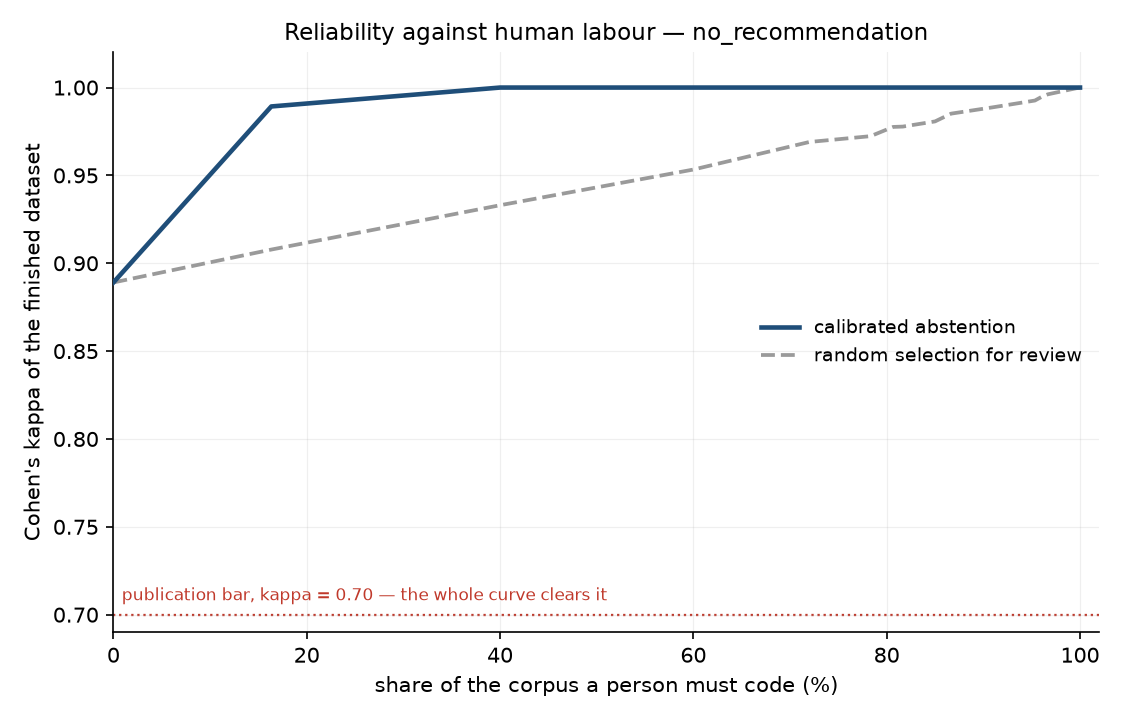
Reliability of the finished dataset against the share of a corpus a person must code, on the worked example in this repository. Choosing which items to hand to a person by calibrated uncertainty reaches κ = 0.99 after coding 16% of the corpus; choosing them at random needs about 95% to get there. The gap is the whole product.
The whole path on a real corpus, in order. Steps 1 to 6 take an afternoon. Step 7 is the one that costs you days, and it is the one that makes the result defensible. To watch the pipeline run end to end first, with no API key and nothing leaving your machine, skip to the offline example.
Python 3.11 or newer. Two routes, and both leave you with the same scruple
command. Pick by whether you want to use the tool or see inside it.
From PyPI. The normal way. Nothing to clone, nothing to build.
pip install 'scruple[all]'    # or: uv add 'scruple[all]'
scruple --version
The [all] extra pulls in the labour chart (matplotlib), Parquet export
(pyarrow) and SPSS/Stata export (pyreadstat). Plain pip install scruple does
everything else, and tells you which extra is missing if you ask for one of
those three. For the newest code ahead of a release, install straight from the
repository without cloning it:
pip install 'git+https://github.com/samugit83/scruple'From a clone. Choose this if you want the worked example, the test suite or the source: the example ships with the repository, not with the package.
git clone https://github.com/samugit83/scruple && cd scruple
uv sync --all-extras
uv run scruple --version
uv sync builds a .venv from the pinned uv.lock, so you get exactly the
dependency versions CI tests against. Commands then run as uv run scruple …
and nothing is installed system-wide. Without uv, the same thing in plain
Python:
python -m venv .venv && source .venv/bin/activate
pip install -e '.[all]'       # -e: your edits take effect immediately
scruple --version
The steps below write scruple. If you took the uv route, write
uv run scruple instead. Everything else is identical.
mkdir vaccine-study && cd vaccine-study
scruple init
scruple.yml |
every setting, commented: split seed, backend, budget, α and δ |
codebook.yml |
a one-code template to replace |
.scruple/ |
project state: the frozen split, your gold judgements, the cache |
data/, out/ |
where the corpus goes, and where exports land |
Get a key from console.typesafe.ai, or use a
Vercel AI Gateway key, and write a .env beside scruple.yml:
JEV_API_KEY=...
.env.example lists the rest: JEV_BASE_URL if you are behind a
proxy, and JEV_MODEL if you need to pin an exact model version, which you do
as soon as published accuracy numbers depend on it.
Add .env to your .gitignore before you commit anything. A key in git
history is a live key forever, even after you delete the file.
Before you send anything. Interview and survey text is usually personal data. If yours is, and a hosted API has not been cleared with your ethics committee, set
backend.name: localinscruple.ymland point it at vLLM, llama.cpp or Ollama instead. Nothing then leaves the machine. See docs/privacy.md.
This is the intellectual work, and nothing here automates it. scruple validates
codebook.yml and never edits or extends it.
version: 1
codes:
  access_barrier:
    type: noul
    definition: >
      The respondent cites a practical obstacle to attending: time, transport,
      clinic opening hours, distance or cost.
    examples_yes:
      - "the clinic closes at five and I work two jobs"
      - "there is no bus out here and I do not drive"
    examples_no:
      - "I just do not think it is necessary"
  procrastination:
    type: noul
    definition: >
      The respondent intended to attend but had not yet got round to it.
    examples_yes:
      - "I keep meaning to book it and forgetting"
    examples_no:
      - "I decided against it deliberately"
Write each definition so that someone else could apply it to an ambiguous
answer and reach the same verdict you would. A vague definition does not fail
quietly here. It comes back in step 8 as NOT_AUTOMATABLE, with the
agreement between your own two coders attached to explain why.
scruple codebook check2 codes, codebook hash dfa429118e34d976
access_barrier d22059a577b2 noul
procrastination 496a67239ca9 noul
Those hashes are provenance. Change a definition and its hash changes, which is
how run later knows your calibration no longer applies to it.
One row per item, a column of text, and ideally a stable id column. Without
one, ids like row_0001 are generated for you. .csv, .tsv, .jsonl, or a
folder of .txt/.md files.
scruple load responses.csv --text-col response --id-col respondent_idloaded 1,200 items from responses.csv
length (characters): median 73, p95 129, max 217
split frozen (seed 42): dev 120, calibration 540, test 540
The split is frozen here, before you have seen any output, and recorded with its seed:
- dev (10%): the only split
trymay draw from, so iterating cannot contaminate the result - calibration (45%): fits the thresholds
- test (45%): produces every number you report
scruple try --n 50Fifty random dev items, so you can see where the model's reading of a definition differs from yours, sharpen the wording, and run it again. Do this now: once you have hand-coded a gold sample against a definition, changing that definition throws the calibration away.
The expensive step, and the one everything downstream rests on.
scruple gold --n 600                         # you
scruple gold --overlap 150 --coder coder_2   # a second coder, same 150 items
gold shows one item and one definition at a time and takes y, n, ? to
skip, b to go back, q to stop. It never shows you model output, and it
records that it did not. The sample is drawn at random from a recorded seed and
you cannot choose the items, because a hand-picked sample breaks the guarantee
silently. Stop whenever you like; re-running resumes where you left off.
The overlap is not a nicety. Those 150 double-coded items give the human-human ceiling, and without it there is no way to tell the model is bad at this code from this code is vague.
Budget roughly 2 hours per 300 short survey answers, nearer 30 for interview passages, and double that for the second coder.
scruple checkFits thresholds on calibration, reports on test, and gives each code a verdict:
| verdict | meaning | what to do |
|---|---|---|
ok |
held-out κ ≥ 0.75 | automate it |
weak |
κ between 0.70 and 0.75 | usable, but report it as such |
NOT_AUTOMATABLE |
κ below the 0.70 publication bar | hand-code it, and read the warning, because if your two coders also disagreed, the definition is what needs fixing |
INSUFFICIENT_EVIDENCE |
too few positives to certify either way | more gold, enriched for that code: scruple gold --enrich <code_id> |
--alpha sets the target per-class error rate (default 0.10) and --delta the
confidence (default 0.05). Tightening α to 0.05 roughly quadruples the gold
sample you need, and check reports the shortfall in items.
scruple runAbove engine.budget_usd in scruple.yml it quotes the projected cost and
asks first; --yes approves in advance. It refuses outright if the codebook or
the chunking changed since calibration. That is what the hashes are for.
Uncertified codes stay yours to code by hand throughout.
scruple review # or: scruple review --limit 50The abstained items, hardest last. This is the 16% on the chart at the top of this page.
scruple export # --format csv | parquet | stata | spssThree files in out/, described next. The third one is the product.
Three files. Every competitor produces the first.
coded.csv gives your original columns, plus three per code: the decision,
the probability, and where it came from.
respondent_id,age_band,response,access_barrier,access_barrier_p,access_barrier_src
R0002,65+,The booking line was engaged every time I rang!,1,0.998,auto
R0419,40-64,"To be fair, just have not got round to it yet.",,0.41,abstain_unreviewed
R0001,65+,"It is on my list, honestly it is...",0,0.0005,human
abstentions.csv holds the items it refused to code, with their
probabilities, hardest cases last. Nobody else produces this.
item_id,code_id,probability,text
R0948,access_barrier,0.59,"To be fair, the booking line was engaged every time I rang, it is complicated."
validation_report.md carries agreement statistics against held-out human
coding, the fitted thresholds, the guarantee and its exact scope, full
provenance down to per-code hashes and the split seed, and a paragraph ready to
paste into a methods section. This is the actual product.
No API key, no network. The example ships a synthetic corpus and recorded probabilities, so the whole pipeline runs offline.
git clone https://github.com/samugit83/scruple && cd scruple
uv sync
cd examples/vaccine_survey

uv run scruple codebook check     # validate the codes
uv run scruple check              # fit thresholds, report on held-out data
uv run scruple run --yes          # code the corpus
uv run scruple export             # write the three output files
scruple check on that example prints:
code                 kappa (held-out)  auto-code  needs you  verdict
access_barrier                   0.98      95.7%       4.3%  ok
distrust_pharma                    --         --         --  NOT_AUTOMATABLE
no_recommendation                0.99      86.7%      13.3%  ok
procrastination                  0.93      98.0%       2.0%  ok
religious_objection                --         --         --  INSUFFICIENT_EVIDENCE (7 positives)
dignity_violation                  --         --         --  NOT_AUTOMATABLE
──────────────────────────────────────────────────────────────────────────
3 of 6 codes usable · 13.3% of items abstained on those · 3 code(s) to code by hand throughout
guarantee: class-conditional error <= 10% per class, confidence 95%, per code

  dignity_violation could not be automated. Your two coders agreed only at
  kappa=0.28 on this code, which suggests the definition is underspecified.
  Consider rewriting it.
Those are real numbers from a real model. Half the codes failed, in three different ways, and the table says which and why. A code two humans cannot agree on is a codebook problem, not a model problem, and being told so is worth more than a number.
Read these before deciding whether this fits your study.
- Deductive coding only. scruple applies the codebook you wrote. It will not discover your categories, and it is not trying to.
- Some codes will be rejected, and that is the tool working. In the example above, three of six were. One was too rare to have enough evidence, one was too error-prone to certify, and one was interpretive enough that the two human coders agreed only at κ = 0.28.
- The guarantee covers the model-decided subset only. Not items routed to you, and not codes that were never certified. The report states this rather than letting you assume otherwise.
- It assumes your gold sample is random, with known inclusion
probabilities. A hand-picked sample breaks it silently, so
scruple goldsamples with a recorded seed and refuses to let you pick. - Gold coding is real work. Roughly 2 hours for 300 short survey answers,
closer to 30 for interview passages, and double that with a second coder.
Certification is limited by the smaller class of each code, so rare codes need
more of it, and
scruple checktells you how many more items, in items. - Below about 200 gold items, the confidence intervals are too wide to support strong claims whatever the point estimates say.
- The automated coder is a coder, not ground truth. Report it as a coder.
| backend | what is transmitted | where |
|---|---|---|
jev |
Full item text and your code definitions | The configured System One endpoint |
openai / anthropic |
Full item text and your code definitions | The vendor's API |
local |
Full item text and your code definitions | Only the endpoint you configure |
recorded |
Nothing | Nothing leaves your machine |
If your corpus is personal data and you have not cleared a hosted API with
your ethics committee, use local. It speaks the OpenAI-compatible chat API,
so vLLM, llama.cpp and Ollama all work. This is not a footnote: sending
interview transcripts to a single-region third-party API will not clear many
European university ethics committees, and a tool those researchers cannot use
does not help them.
The cache stores hashes only, never text, so scruple purge --gold destroys
the personal data while leaving the expensive model work intact. Details in
docs/privacy.md, including the threat model for untrusted
corpus text.
The statistics are the product. docs/methodology.md describes them for a methodologist reading sceptically: the three-way split, the class-conditional risk control and why a marginal one is degenerate, the arithmetic for how much gold coding you need, why selective κ is a diagnostic rather than the headline, and a section on exactly what the guarantee does not cover.
The layer is verified rather than asserted: 100% line and branch coverage enforced in CI, κ and α implemented independently from their own definitions so their agreement is a real cross-check, and the guarantee itself validated by simulation: thresholds fitted on one sample, realised error measured on a fresh one, 1,000 trials per prevalence down to 2%.
uv run pytest tests/statistical -q # the guarantee, by simulationEach run emits a paragraph like this, which you edit rather than paste blind:
Open-ended responses (n = 1,200) were coded deductively against an author-written codebook of 6 binary codes using scruple 0.1.0, with jev providing calibrated probabilities. A random sample of 600 responses was hand-coded blind, without sight of model output, and partitioned into disjoint calibration and test sets fixed in advance (seed 42). Per-code decision thresholds were selected on the calibration set so that the class-conditional error rate, computed separately within each true class, was at most 10% with 95% confidence […]
| NVivo / MAXQDA / ATLAS.ti | LLM coding scripts | scruple | |
|---|---|---|---|
| Codebook management, memoing, project organisation | Far better. Years of work you should not rebuild | No | No |
| Theme discovery, inductive analysis | Yes | Yes | No, out of scope by design |
| Multimedia, team collaboration, visualisation | Yes | No | No |
| Codes a full corpus quickly | Partially | Yes | Yes |
| Refuses items it cannot code reliably | No | No | Yes |
| Reports reliability against blind human coding | Computes κ if you supply both codings | Rarely | Yes, always |
| A guarantee with a stated scope and assumption | No | No | Yes |
scruple is not a replacement for a QDA package. It is the validation step those tools do not have, and it is deliberately narrow: it does one thing, and it tells you when it cannot do it.
@software{scruple,
  title  = {scruple: calibrated deductive coding with abstention and a
            class-conditional reliability guarantee},
  year   = {2026},
  url    = {https://github.com/samugit83/scruple},
  license = {MIT}
}
Machine-readable metadata is in CITATION.cff. If you use this in published work, please cite it, and please report what it refused, not only what it coded.
Early. The statistics layer and the CLI are complete and tested; the R package and the ordinal and categorical code types are not yet built. The benchmark that the design's kill criterion rests on has not been run against published qualitative-coding corpora, so the headline claim above is demonstrated on a synthetic corpus with a real model, not yet on the literature's datasets.
Licence: MIT. Contributing: CONTRIBUTING.md.