A modern, minimalist HTTP web framework for Go inspired by the elegant developer experience of FastAPI.
Okapi focuses on clarity, strong typing, automatic validation, and built-in OpenAPI documentation, making it easy to build production-ready APIs without boilerplate.






Named after the okapi, a rare and graceful mammal native to the rainforests of northeastern Democratic Republic of the Congo — Okapi blends simplicity, elegance, and strength into a powerful framework for building Go web services.
Go developers often combine multiple libraries for routing, validation, documentation, authentication, and testing.
Okapi brings all these capabilities together in one cohesive framework while remaining fully compatible with Go’s standard net/http.
Key goals:
- Developer experience similar to FastAPI
- Minimal boilerplate
- Strong typing
- Built-in OpenAPI documentation
- Production-ready features out of the box
- Intuitive API Design – Clean, declarative syntax for routes and middleware.
- Automatic Request Binding – Parse JSON, XML, forms, query params, headers, and path variables into structs
- Built-in Validation – Struct tag-based validation with comprehensive error messages.
- Auto-Generated OpenAPI Docs – Swagger UI and ReDoc automatically synced with your code.
- Runtime Documentation Control – Enable/disable OpenAPI docs at runtime without redeployment
- Authentication Ready – Native JWT, Basic Auth, and extensible middleware support.
- Standard Library Compatible – Fully compatible with Go’s
net/http. - Dynamic Route Management – Enable/disable routes at runtime without code changes
- Production Ready – TLS support, CORS, graceful shutdown, middleware system, and more.
mkdir myapi && cd myapi
go mod init myapi
go get github.com/jkaninda/okapi@latestpackage main
import "github.com/jkaninda/okapi"
func main() {
o := okapi.Default()
o.Get("/", func(c *okapi.Context) error {
return c.OK(okapi.M{
"message": "Hello from Okapi!",
})
})
err := o.Start()
if err != nil {
panic(err)
}
}Run the application:
go run main.go
Visit:
- API → http://localhost:8080
- Swagger Docs → http://localhost:8080/docs
- ReDoc → http://localhost:8080/redoc
Okapi supports multiple binding styles, from simple handlers to fully typed input/output patterns.
Define validation rules directly on your structs:
type Book struct {
    Name   string `json:"name" minLength:"4" maxLength:"50" required:"true" pattern:"^[A-Za-z]+$"`
    Price  int    `json:"price" required:"true" min:"5" max:"100"`
    Year   int    `json:"year" deprecated:"true"`
    Status string `json:"status" enum:"available,out_of_stock,discontinued" default:"available"`
}The simplest approach to bind and validate within your handler:
o.Post("/books", func(c *okapi.Context) error {
    var book Book
    if err := c.Bind(&book); err != nil {
        return c.ErrorBadRequest(err)
    }
    return c.Created(book)
})Automatic input binding with a typed handler signature:
o.Post("/books", okapi.Handle(func(c *okapi.Context, book *Book) error {
    book.ID = generateID()
    return c.Created(book)
}),
    okapi.DocRequestBody(&Book{}),
    okapi.DocResponse(&Book{}),
)A concise version for simple input validation:
type BookDetailInput struct {
    ID int `path:"id"`
}

o.Get("/books/{id:int}", okapi.H(func(c *okapi.Context, input *BookDetailInput) error {
    book := findBookByID(input.ID)
    if book == nil {
        return c.AbortNotFound("Book not found")
    }
    return c.OK(book)
}))Define both input and output structs separately for complex operations:
type BookEditInput struct {
    ID   int  `path:"id" required:"true"`
    Body Book `json:"body"`
}

type BookOutput struct {
    Status int
    Body   Book
}

o.Put("/books/{id:int}", okapi.HandleIO(func(c *okapi.Context, input *BookEditInput) (*BookOutput, error) {
    book := updateBook(input.ID, input.Body)
    if book == nil {
        return nil, c.AbortNotFound("Book not found")
    }
    return &BookOutput{Body: *book}, nil
})).WithIO(&BookEditInput{}, &BookOutput{})When you only need a structured output without specific input validation:
type BooksResponse struct {
    Body []Book `json:"books"`
}

o.Get("/books", okapi.HandleO(func(c *okapi.Context) (*BooksResponse, error) {
    return &BooksResponse{Body: getAllBooks()}, nil
})).WithOutput(&BooksResponse{})Separate payload from metadata using the Body field pattern:
type BookRequest struct {
    Body   Book   `json:"body"`              // Request payload
    ID     int    `param:"id" query:"id"`    // Path or query parameter
    APIKey string `header:"X-API-Key" required:"true"` // Header
}

type BookResponse struct {
    Status    int    // HTTP status code
    Body      Book   // Response payload
    RequestID string `header:"X-Request-ID"` // Response header
}


o.Post("/books", func(c *okapi.Context) error {
    var req BookRequest
    if err := c.Bind(&req); err != nil {
        return c.ErrorBadRequest(err)
    }

    res := &BookResponse{
        Status:    201,
        RequestID: uuid.New().String(),
        Body:      req.Body,
    }
    return c.Respond(res) // Automatically sets status, headers, and body
},
    okapi.Request(&BookRequest{}),
    okapi.Response(BookResponse{}),
)api := o.Group("/api")
// Versioned API groups
v1 := api.Group("/v1", authMiddleware).Deprecated()
v2 := api.Group("/v2")
v1.Get("/books", getBooks)
v2.Get("/books", v2GetBooks)
// Disable routes at runtime
v2.Get("/experimental", experimentalHandler).Disable()
// Apply middleware to individual routes
v2.Get("/books/{id}", getBookByID).Use(cacheMiddleware)
// Protected admin routes
admin := api.Group("/admin", adminMiddleware)
admin.Get("/dashboard", getDashboard)Ideal for controller or service-based architectures:
type BookService struct{}

func (s *BookService) Routes() []okapi.RouteDefinition {
    apiGroup := &okapi.Group{Prefix: "/api"}

    return []okapi.RouteDefinition{
        {
            Method:      http.MethodGet,
            Path:        "/books",
            Handler:     s.List,
            Group:       apiGroup,
            Summary:     "List all books",
            Response:    &BooksResponse{},
        },
        {
            Method:      http.MethodPost,
            Path:        "/books",
            Handler:     s.Create,
            Group:       apiGroup,
            Middlewares: []okapi.Middleware{authMiddleware},
            Security:    bearerAuthSecurity,
            Options: []okapi.RouteOption{
                okapi.DocSummary("Create a book"),
                okapi.DocRequestBody(&Book{}),
                okapi.DocResponse(&Book{}),
            },
        },
    }
}

// Register routes
app := okapi.Default()
bookService := &BookService{}
app.Register(bookService.Routes()...)jwtAuth := okapi.JWTAuth{
SigningSecret: []byte("your-secret-key"),
Issuer: "okapi",
Audience: "okapi.jkaninda.dev",
ClaimsExpression: "Equals(`email_verified`, `true`)",
TokenLookup: "header:Authorization",
ContextKey: "user",
}
protected := o.Group("/api", jwtAuth.Middleware).WithBearerAuth()
protected.Get("/profile", getProfile)basicAuth := okapi.BasicAuth{
Username: "admin",
Password: "secure-password",
}
admin := o.Group("/admin", basicAuth.Middleware)
admin.Get("/dashboard", getDashboard)func main() {
tmpl, _ := okapi.NewTemplateFromDirectory("views", ".html")
o := okapi.Default().WithRenderer(tmpl)
o.Get("/", func(c *okapi.Context) error {
return c.Render(http.StatusOK, "home", okapi.M{
"title": "Welcome",
"message": "Hello, World!",
})
})
o.Start()
}//go:embed views/*
var Views embed.FS
func main() {
app := okapi.New()
app.WithRendererFromFS(Views, "views/*.html")
app.StaticFS("/assets", http.FS(must(fs.Sub(Views, "views/assets"))))
app.Start()
}import "github.com/jkaninda/okapi/okapitest"
func TestGetBooks(t *testing.T) {
server := okapi.NewTestServer(t)
server.Get("/books", GetBooksHandler)
okapitest.GET(t, server.BaseURL+"/books").
ExpectStatusOK().
ExpectBodyContains("Go Programming").
ExpectHeader("Content-Type", "application/json")
}import "github.com/jkaninda/okapi/okapicli"
func main() {
o := okapi.Default()
cli := okapicli.New(o, "My API").
String("config", "c", "config.yaml", "Config file").
Int("port", "p", 8000, "Server port").
Bool("debug", "d", false, "Debug mode")
cli.Parse()
o.WithPort(cli.GetInt("port"))
// ... register routes ...
cli.Run()
}Okapi automatically generates interactive API documentation with multiple approaches to document your routes.
With okapi.Default() – Documentation is enabled by default at /docs and /redoc.
With okapi.New() – Documentation is disabled by default. Enable it conditionally:
o := okapi.New()

if os.Getenv("ENABLE_DOCS") == "true" {
    o.WithOpenAPIDocs()
}Simple and readable for most routes:
o.Get("/books", getBooksHandler,
    okapi.DocSummary("List all available books"),
    okapi.DocTags("Books"),
    okapi.DocQueryParam("author", "string", "Filter by author name", false),
    okapi.DocQueryParam("limit", "int", "Maximum results to return", false),
    okapi.DocResponseHeader("X-Client-Id", "string", "Client ID"),
    okapi.DocResponse([]Book{}),
    okapi.DocResponse(400, ErrorResponse{}),
)For complex or dynamic documentation needs:
o.Post("/books", createBookHandler,
    okapi.Doc().
        Summary("Add a new book to the inventory").
        Tags("Books").
        BearerAuth().
        ResponseHeader("X-Client-Id", "string", "Client ID").
        RequestBody(BookRequest{}).
        Response(201, Book{}).
        Response(400, ErrorResponse{}).
        Build(),
)Define request/response metadata directly in structs:
type BookRequest struct {
    Body struct {
        Name  string `json:"name" minLength:"4" maxLength:"50" required:"true"`
        Price int    `json:"price" required:"true"`
    } `json:"body"`
    ID     int    `param:"id" query:"id"`
    APIKey string `header:"X-API-Key" required:"true"`
}

o.Post("/books", createBookHandler,
    okapi.Request(&BookRequest{}),
    okapi.Response(&BookResponse{}),
)Chain documentation directly on route definitions:
o.Post("/books", handler).WithIO(&BookRequest{}, &BookResponse{})  // Both request & response
o.Post("/books", handler).WithInput(&BookRequest{})                 // Request only
o.Get("/books", handler).WithOutput(&BooksResponse{})               // Response only
See the full guide at okapi.jkaninda.dev/features/openapi
Swagger UI (/docs) |
ReDoc (/redoc) |
|---|---|
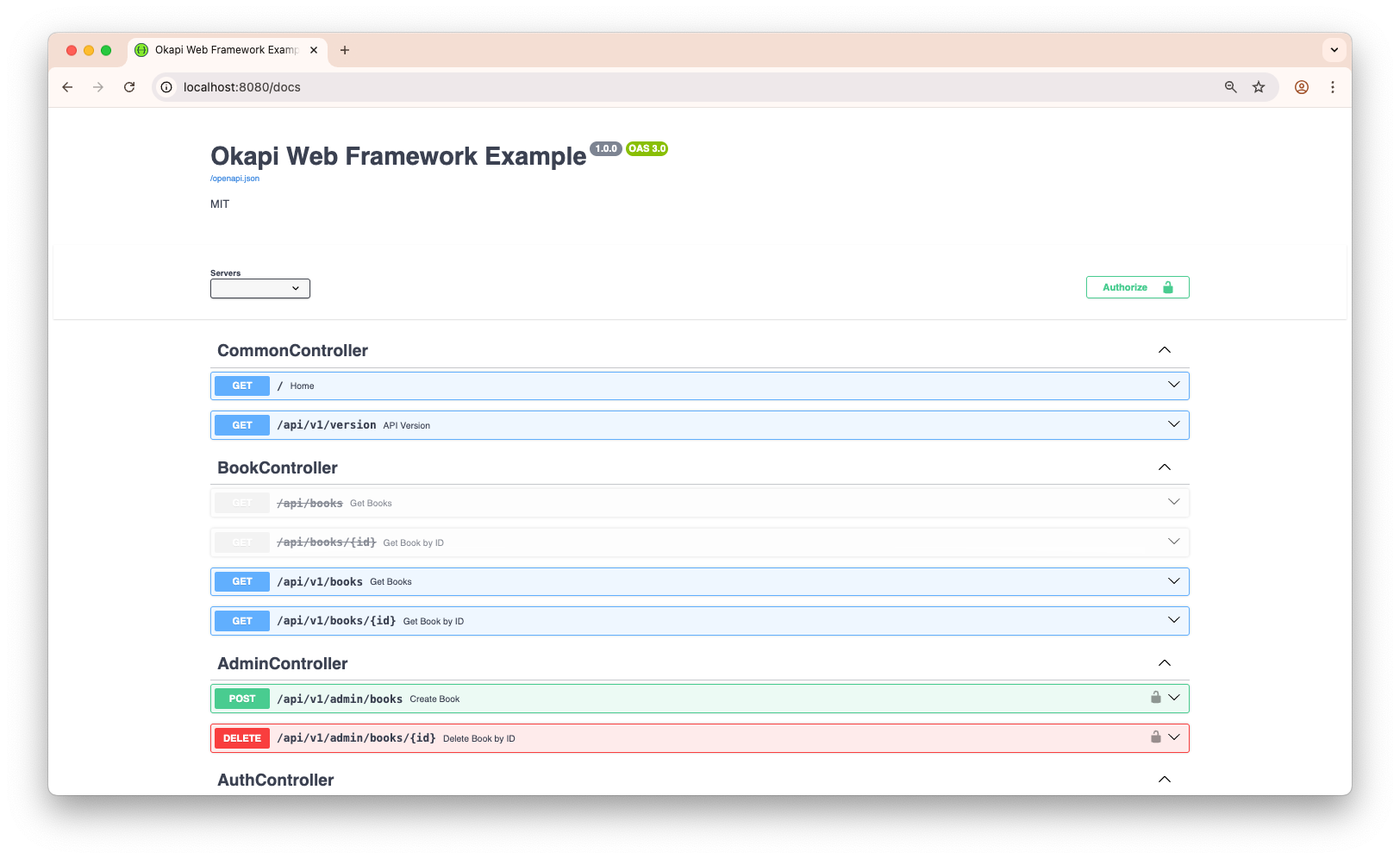 |
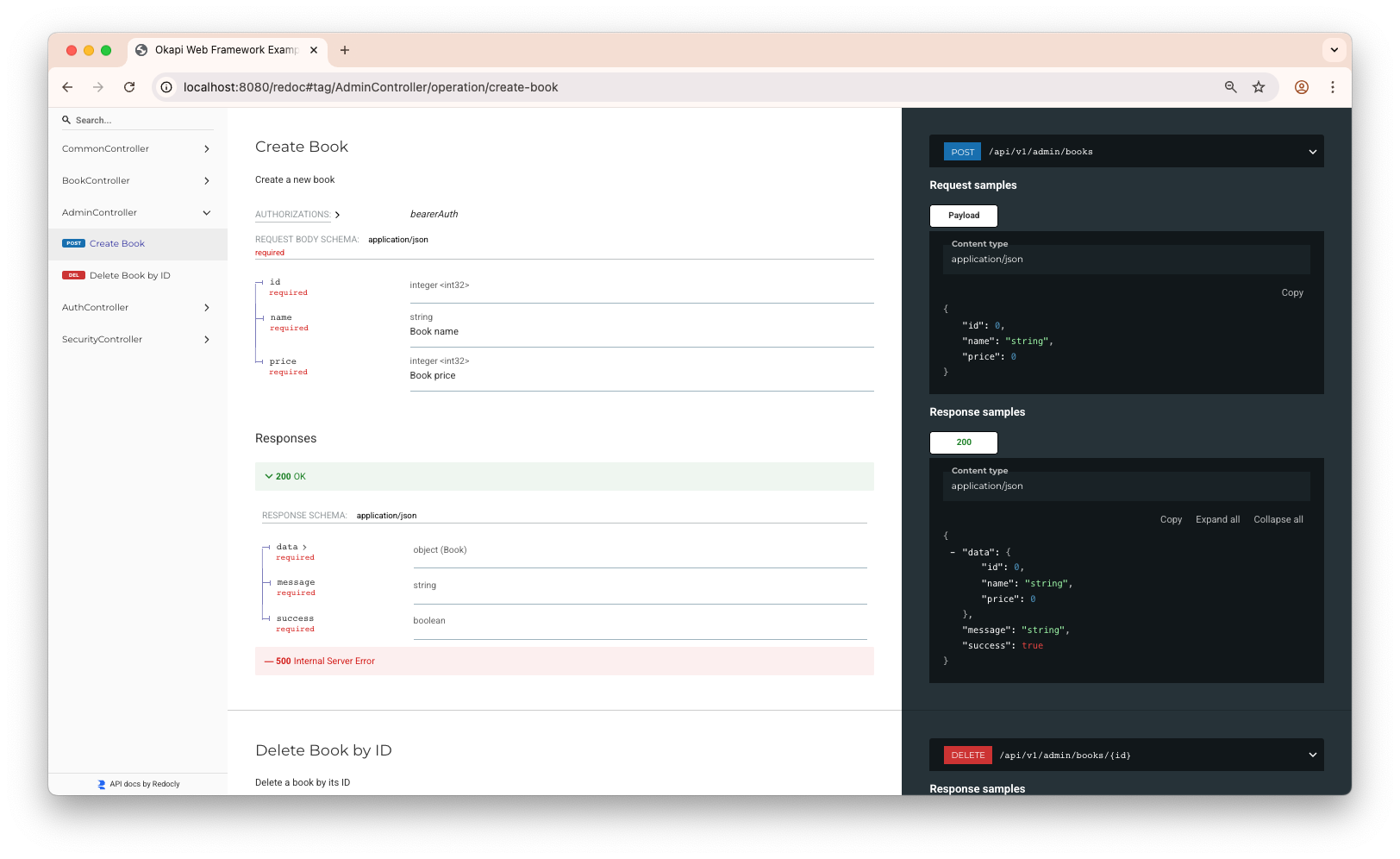 |
Full documentation available at okapi.jkaninda.dev
Topics covered: Routing, Request Binding, Validation, Responses, Middleware, Authentication, OpenAPI, Testing, TLS, CORS, Graceful Shutdown, and more.
Building microservices? Check out Goma Gateway a high-performance API Gateway with authentication, rate limiting, load balancing, and support for REST, GraphQL, gRPC, TCP, and UDP.
- Posta — Self-hosted email delivery platform. Send emails via HTTP API with SMTP delivery, templates, storage, and analytics.
- Goma Admin — Control plane for Goma Gateway. Manage, configure, and monitor distributed API gateways from a unified dashboard.
Both Okapi and Huma aim to improve developer experience in Go APIs with strong typing and OpenAPI integration. The key difference is philosophy: Okapi is a batteries-included web framework, while Huma is an API layer designed to sit on top of existing routers.
| Feature / Aspect | Okapi | Huma |
|---|---|---|
| Positioning | Full web framework | API framework built on top of existing routers |
| Router | Built-in high-performance router | Uses external routers (Chi, httprouter, Fiber, etc.) |
| OpenAPI Generation | Native, framework-level (Swagger UI & Redoc included) | Native, schema-first API design |
| Request Binding | Unified binder for JSON, XML, forms, query, headers, path params | Struct tags + resolver pattern for headers, query, path params |
| Validation | Tag-based (min, max, enum, required, default, pattern, etc.) | Included |
| Response Modeling | Output structs with Body pattern; headers & status via struct fields |
Strongly typed response models with similar patterns |
| Middleware | Built-in + custom middleware, groups, per-route middleware | Router middleware + Huma-specific middleware and transformers |
| Authentication | Built-in JWT, Basic Auth, security schemes for OpenAPI | Security schemes via OpenAPI; middleware via router |
| Dynamic Route Management | Enable/disable routes & groups at runtime | Not a core feature |
| Templating / HTML | Built-in rendering (HTML templates, static files) | API-focused; not intended for HTML apps |
| CLI Integration | Built-in CLI support (flags, env config) | Included |
| Testing Utilities | Built-in test server and fluent HTTP assertions | Relies on standard Go testing tools |
| Learning Curve | Very approachable for Go web developers | Slightly steeper (requires OpenAPI-first mental model) |
| Use Case Fit | Full web apps, APIs, gateways, microservices | Pure API services, schema-first API design |
| Philosophy | "FastAPI-like DX for Go, batteries included" | "OpenAPI-first typed APIs on top of your router of choice" |
Okapi — define a route with built-in validation and OpenAPI metadata:
app:=okapi.Default()
app.Register(okapi.RouteDefinition{
     Method:      http.MethodPost,
     Path:        "/users",
     Handler:     createUser,
     OperationId: "create-user",
     Summary:     "Create a new user",
     Tags: []string{"users"},
     Request: &UserRequest{},
     Response:    &User{},
     Options: []okapi.RouteOption{
	    okapi.DocErrorResponse(401, &ErrorUnauthorized{}),
	    okapi.DocErrorResponse(404, &ErrorNotFound{}),
	},
})
Huma — similar concept, different style:
huma.Register(api, huma.Operation{
    OperationID: "create-user",
    Method:      http.MethodPost,
    Path:        "/users",
    Summary:     "Create a new user",
    Tags:        []string{"Users"},
}, createUser)
Both approaches generate OpenAPI documentation automatically.
- Fork the repository
- Create a feature branch (
git checkout -b feature/amazing-feature) - Commit your changes (
git commit -m 'Add amazing feature') - Push to the branch (
git push origin feature/amazing-feature) - Open a Pull Request
- Documentation: okapi.jkaninda.dev
- Issues: GitHub Issues
- Discussions: GitHub Discussions
- LinkedIn: Jonas Kaninda
MIT License - see LICENSE for details.
Made with ❤️ for the Go community
⭐ Star us on GitHub — it motivates us to keep improving!
Copyright © 2025 Jonas Kaninda