
So you know DSA and small projects you've coded, right? But have you ever wondered how many cores your calculator program or Tic-Tac-Toe AI actually uses on your 8-core CPU? Probably just one. That's because most programs run sequentially—one instruction at a time. (No wonder your "find the shortest route for the micromouse" algorithm timed out—poor thing was running on a single core, struggling through every possible path!)
Now imagine you want to simulate the weather for the next week, train a neural network, or run a massive physics simulation. Doing it on a single core would take forever. That's where parallel computing comes in: it lets you split the work across multiple cores, CPUs, GPUs, or even supercomputers, making huge computations run much faster.
Read the full blog post: Parallel Computing 101: A Beginner's Guide to OpenMP, MPI, and CUDA
Sequential processing takes too long, so we use parallel computing, which splits programs into smaller tasks that run simultaneously across CPU cores, multiple machines, or thousands of GPU cores.
- Weather prediction: Simulating temperature, wind, and rainfall at once across different regions
- Scientific simulations: Chemistry, physics, biology experiments with thousands of calculations happening simultaneously
- Machine learning & AI: Training deep learning models on GPUs can take hours instead of days
- Gaming & Finance: Real-time simulations, risk analysis, rendering 3D graphics—all happen in parallel
- Supercomputing tasks: Climate models, physics simulations, genome sequencing
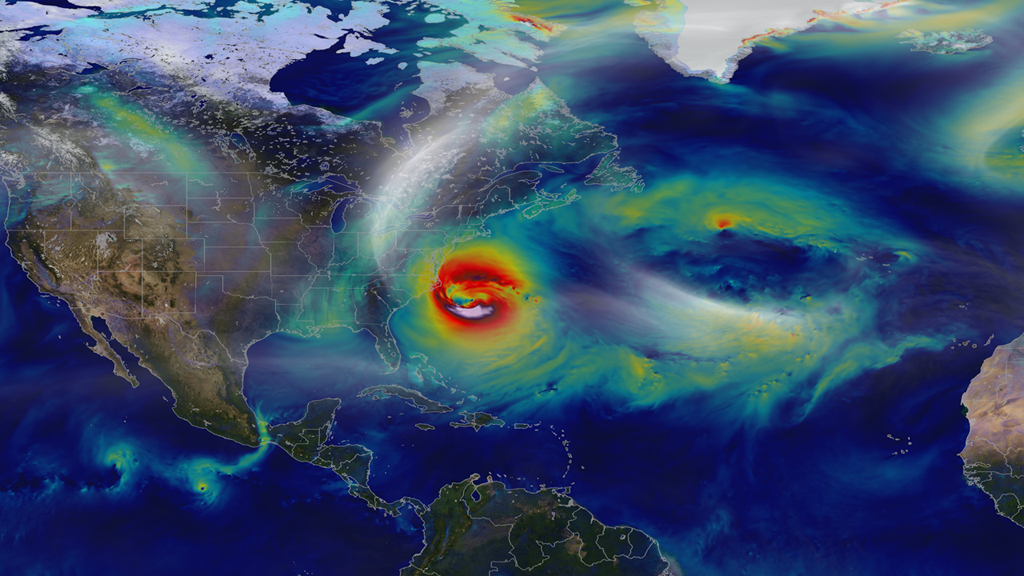
Image: Hurricane Sandy visualization — NASA Scientific Visualization Studio
So now that we get why parallel computing matters, let's actually look at how we can do it.
There are a few popular frameworks that make it easy to write parallel programs—and don't worry, they're not as scary as they sound.
We'll explore three of them:
Makes your CPU multi-core friendly. Just sprinkle a few directives and your loops run in parallel.
Perfect for: Multi-threaded applications on shared-memory systems
Examples in this repo:
- Hello World with OpenMP
- Parallel loops and reductions
- Matrix multiplication with threading
Great for distributed systems, like clusters or cloud VMs, where multiple processes communicate.
Perfect for: Large-scale distributed computing across multiple machines
Examples in this repo:
- Basic MPI communication
- Collective operations (broadcast, reduce, scatter/gather)
- Distributed matrix multiplication
Lets your program use thousands of GPU cores, perfect for heavy computations like matrix math or AI.
Perfect for: Massively parallel computations on NVIDIA GPUs
Examples in this repo:
- CUDA Hello World
- Tiled matrix multiplication
- GPU memory management
OOP is great for organizing and reusing code, but in parallel computing, the focus is on speed and hardware efficiency. So, we keep it simple and procedural—just loops and data—making it easier to split work across threads or processes.
parallel-101/
├── OpenMP/          # OpenMP examples and tutorials
│   ├── hello/       # Basic OpenMP programs
│   ├── loop/        # Parallel loop patterns
│   └── matrix/      # Matrix multiplication
├── MPI/             # MPI examples and tutorials
│   ├── hello/       # Basic MPI programs
│   ├── comm/        # Communication patterns
│   └── matrix/      # Distributed matrix multiplication
├── CUDA/            # CUDA examples and tutorials
│   ├── hello/       # Basic CUDA programs
│   └── matrix/      # GPU matrix multiplication
└── images/          # Project images and diagrams
Depending on which framework you want to explore, you'll need:
For OpenMP:
- GCC compiler with OpenMP support (usually built-in)
gccorclangwith-fopenmpflag
For MPI:
- MPI implementation (OpenMPI or MPICH)
- Install on macOS:
brew install open-mpi
For CUDA:
- NVIDIA GPU with CUDA support
- CUDA Toolkit from NVIDIA
nvcccompiler
-
Clone this repository:
git clone https://github.com/NayanthaNethsara/parallel-101.git cd parallel-101 -
Choose your framework and navigate to the respective directory:
- For OpenMP:
cd OpenMP/ - For MPI:
cd MPI/ - For CUDA:
cd CUDA/
- For OpenMP:
-
Follow the README in each directory for specific compilation and execution instructions.
We recommend exploring the frameworks in this order:
- Start with OpenMP - Easiest to set up, runs on your local machine
- Move to MPI - Learn distributed computing concepts
- Try CUDA - Dive into GPU programming (requires NVIDIA GPU)
Each directory contains progressive examples from "Hello World" to more complex applications like matrix multiplication.
Throughout this repository, you'll find performance benchmarks comparing:
- Sequential vs. Parallel execution
- Different optimization techniques
- Scaling across multiple cores/processes/GPUs
Check the individual READMEs and log files in each implementation for detailed performance metrics.
Found a bug? Want to add more examples? Contributions are welcome! Feel free to:
- Open an issue
- Submit a pull request
- Suggest new examples or frameworks
This project is open source and available for educational purposes.
Happy Parallel Computing!
Remember: With great power (cores) comes great responsibility (avoiding race conditions)!