Your AI wrote the tests. Who tested the tests?






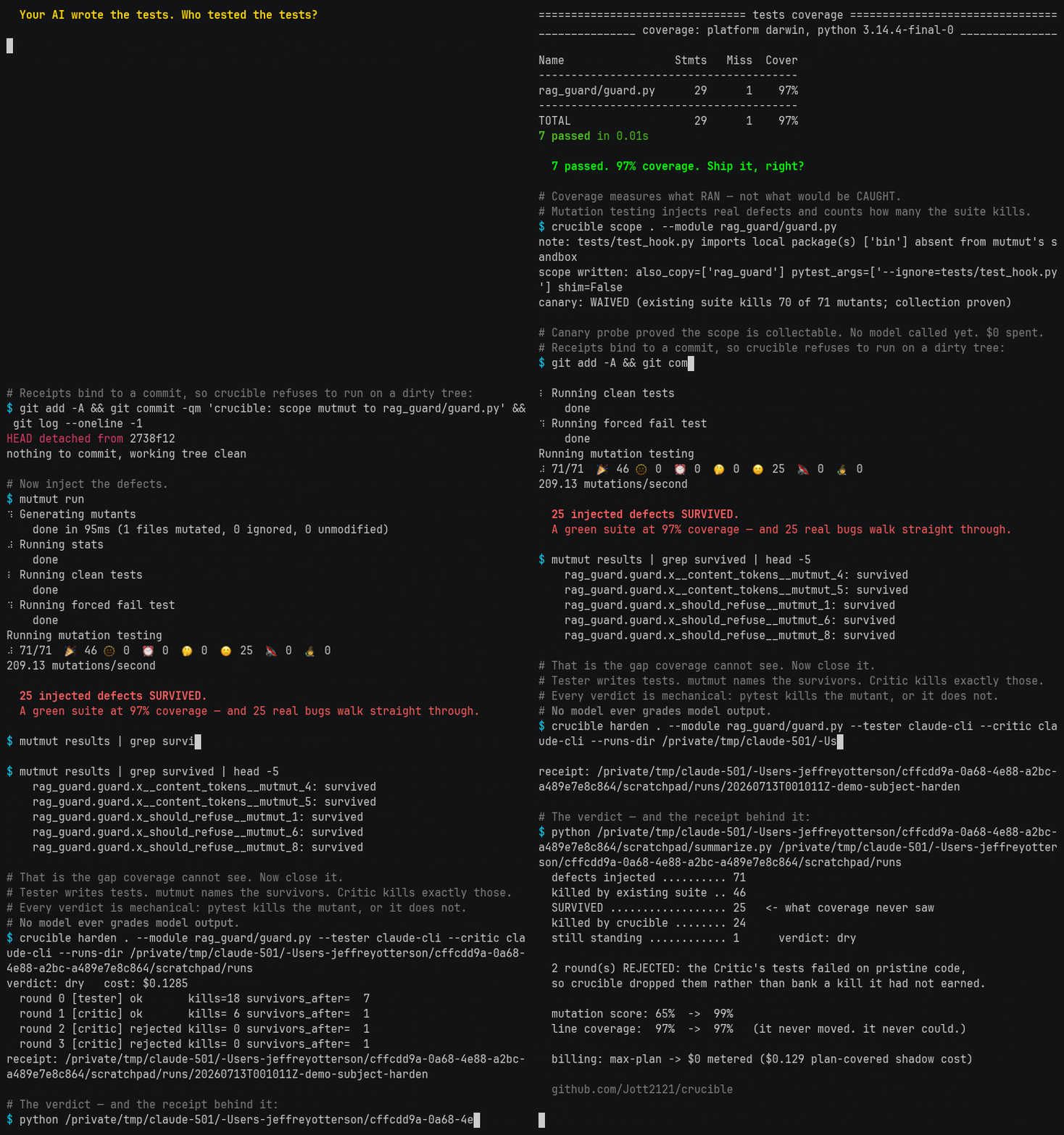
Recorded live — every command really ran, and every number in it is read back from that run's own receipt. Sped up for viewing; replay the raw cast at real speed. Full landing page: jott2121.github.io/crucible
That module has 7 passing tests and 97% line coverage. Mutation testing injects 71 real defects. The suite kills 46. 25 survive — twenty-five real bugs walking straight through a green build.
crucible kills 24 of the 25, and then does the more important thing: in two rounds the Critic
wrote tests that failed on pristine code, and crucible threw them out rather than bank a
kill it hadn't earned. The loop ends dry with one mutant still standing, and says so. Mutation
score 65% → 99%; line coverage never moves off 97% the entire time. Coverage was never the
thing measuring your safety.
An earlier run on the same module killed all 25 (clean). Same tool, same module, different day —
model nondeterminism is real, and the receipts record both rather than only the flattering one.
The diagnose costs nothing and calls no model. Point the Action at a module and every pull request tells you how many real bugs your suite would actually have caught:
- uses: Jott2121/crucible@v1
  with:
    module: yourpkg/yourmodule.py    # omit if your repo already configures [tool.mutmut]
    fail-under: "70"                 # optional: red the build below this
It comments the score and names the survivors. No model, no API key, $0 — the number that
embarrasses a coverage badge is free to compute, and you should not need a subscription to be told
the truth about your own tests.
For the badge, set badge-file: mutation.json, publish it, and point shields.io at it. The payload
lives in your repo — there is no badge service of mine sitting in the middle of your CI, and no
uptime I owe you. The badge at the top of this page is generated exactly that way, by this Action,
on this repo:
[](...)Or just run it locally, on any repo, right now:
crucible score . --module yourpkg/yourmodule.py --coverage 97
97% line coverage, but 25 of 71 injected defects SURVIVED this suite (46 killed, mutation score 65%).
Coverage measures what ran, not what would be caught. Mutation testing injects real defects and counts how many your suite kills — and AI-written suites routinely leave survivors. crucible closes the loop: a Tester agent writes tests, mutmut finds the survivors — injected defects no test caught — and a Critic agent is handed the named survivors and writes tests to kill exactly those. Every verdict is mechanical: pytest kills the mutant or it survives. No model ever grades model output.
Find out what your existing tests actually miss, on your own repo:
pip install crucible-harden       # the command it installs is `crucible`

cd /path/to/your-repo-clone       # work in a clone: crucible writes scope config
crucible score . --module yourpkg/yourmodule.py --coverage 97

97% line coverage, but 25 of 71 injected defects SURVIVED this suite (46 killed, mutation score 65%).
No model is called and no API key is needed. crucible score detects your layout, writes the
mutation scope, and runs mutmut on it. For the airtight pre-flight check — a $0 canary that
refuses (exit 4) unless a freshly written test actually collects and registers a kill under your
scope — run crucible scope first (the bundled harden ritual does). If your repo already
configures [tool.mutmut], drop --module and crucible grades the scope you chose instead of
overwriting it.
The survivor count is plain mutation testing on your own suite. No AI is involved yet — the number that embarrasses a coverage badge is free to compute.
Nothing to install, if you have uv:
uvx --from crucible-harden crucible score . --module yourpkg/yourmodule.py
(uvx runs crucible in its own throwaway environment. That is fine when your tests import your
package from the working tree, as above; if they need it installed — a src-layout project, say —
use the pip install path into the environment your tests already run in.)
There is no MCP server here, on purpose. crucible score is a shell command that prints a number
and names the survivors, so any agent that can run a command can already use it — Cursor, Cline,
Windsurf, Codex, Copilot, or a plain terminal. Point yours at this:
Run
uvx --from crucible-harden crucible score . --module <the module you just wrote tests for>. It injects real defects and reports how many the test suite actually kills. Anything in thesurvivorslist is a bug the suite would let through. Write tests that kill those specific mutants, then re-run to confirm the count dropped.
The harden loop is deliberately not exposed as a tool call: it runs for minutes, writes files, and creates git branches, so a client timeout and retry would re-run the whole thing and re-spend for it. Guardrails belong in the operator's ritual, not in an arbitrary caller's hands — which is what the Claude Code skill below encodes.
/plugin marketplace add Jott2121/crucible
/plugin install crucible-harden@crucible
Installs the harden-tests skill, which drives the full ritual: preflight, local branch, the free
scope canary, the loop, and a receipted report. It requires pip install crucible-harden as well —
the plugin is the procedure, the package is the tool.
crucible harden . --module yourpkg/yourmodule.py \
    --tester claude-cli --critic claude-cli --runs-dir ~/.crucible-runs/yourrepo
With claude-cli, model calls run through Claude Code headless on your Claude subscription —
$0 metered spend, and every run's meta.json records billing: max-plan so plan-covered
shadow dollars are never mistaken for an invoice. No subscription? --tester anthropic uses the
metered API via ANTHROPIC_API_KEY.
Lean invocation is the default: the subprocess runs with --tools "", collapsing Claude
Code's agent loop to a single completion. On the reference run (rag_guard/guard.py), that
took the harden from 439,230 to 3,641 input tokens (120.6×), with identical results — the
same 25/25 surviving mutants killed (receipts 20260712T050833Z vs 20260712T171312Z).
Measured on that run's receipts, not a universal constant. CRUCIBLE_LEAN=0 restores the
ambient invocation.
Every run writes a receipt directory:
meta.json         # models, billing (api vs max-plan), lean_isolation rung, scope commit
receipt.jsonl     # one line per round: tokens in/out, cost, kills, survivors, prompt hash
result.json       # verdict + totals
Generated tests are written into the working tree of wherever you run it — so run it on a
throwaway branch; the bundled harden-tests skill (skills/harden-tests/, installable as a
Claude Code plugin) enforces the full ritual: local branch only, never main, PR strictly
opt-in. If the canary can't prove your scope, crucible refuses instead of spending tokens.
Those generated tests are model-written Python that pytest then executes on your machine —
crucible discards any that fail on pristine code, but it does not sandbox execution.
Two pre-registered experiments (experiments/PROTOCOL.md, experiments/PROTOCOL-B.md).
Experiment 1 ran five subjects across three arms (one-shot, same-lineage adversarial loop,
cross-lineage adversarial loop). The loop-arm pipeline outscored one-shot 105 discordant kills to
0 (pooled exact McNemar p = 4.9×10⁻³²) — a pipeline-level replication of the direction
established by MuTAP, AdverTest, and Meta's ACH (docs/RELATED-WORK.md); because each arm drew
its own round-0 suite, it is not a causal estimate of the loop, a confound an external
cross-model review of the draft paper caught. Experiment 2 removed it: one frozen round-0
suite per replicate (5 per subject × 4 subjects), committed before its continuations, all three
arms run from that identical state. Within that design the Critic loop's incremental effect is
causal and large: a mean 78% of the survivors the frozen round-0 left standing were killed by
the critic rounds (rate 0.783, 95% bootstrap interval [0.592, 0.935]). The cross-provider
critic configuration — pre-registered as a no-verdict pilot — showed a positive within-replicate
difference (rate gap 0.178 [0.039, 0.347]; direction stable under every leave-one-out
sensitivity, magnitude 59% driven by one receipted truncation failure) at 5.5× lower arm cost.
An earlier analysis had shown an apparently overwhelming cross-lineage effect; the autopsy
traced it to silent output truncation deleting one arm's rounds — an instrument artifact, not a
model difference — and the same mechanism recurred three times in Experiment 2, this time
mechanically detected and honestly scored. That autopsy and the fail-closed instrumentation
built from it are the finding. Full tables: experiments/RESULTS.md
(Experiment 1), experiments/RESULTS-B.md (Experiment 2), and the
paper draft with its complete cross-model review trail in paper/.
The claims above are checkable: both experiments were pre-registered before results existed
(Experiment 2's protocol was pushed publicly before its runner was even built), and
inconclusive or corrected results are published at the same prominence as positive ones —
including a manufactured effect the instrument itself produced, autopsied with receipts.
Additionally, the prior art is cited rather than rediscovered (docs/RELATED-WORK.md), and the
tool is dogfooded — crucible's own modules run under the same mutation gate, current score
and survivor dispositions in docs/MUTATION.md.
Honest answer first: the core loop is the same, and you can hand-roll it. A model writing tests against mutmut's survivor list is exactly what a good one-file workflow does, and for strengthening a single suite on your own machine that workflow is genuinely fine. crucible is not a different algorithm. What it adds is the discipline that makes the result trustworthy to someone who was not watching it run:
- It refuses to spend a token on a scope it has not proven is real.
crucible scoperuns a$0canary probe before any model is called: it proves the scope actually generates mutants and that a freshly written test really gets collected and registers a kill — or that your existing suite already kills under it. A scope it cannot prove is a refusal (exit 4), not a run, and the bundled harden ritual runs this gate first — so the failure where a model happily writes tests nothing ever executes burns zero tokens instead of a budget. - The loop is iterated, not a single pass. A separate Critic re-attacks whatever is still surviving, round after round, until dry or a cap. On the frozen round-0 experiment (same-lineage arm, 4 subjects × 5 replicates) the critic rounds killed a mean 78% of the survivors a single generation left standing (0.783, 95% bootstrap interval [0.592, 0.935]) — measured, not asserted (full tables).
- It is strictly add-only. Generated tests are only ever added; an
assert_add_onlyguard trips if a run would edit or delete anything already in your suite. (crucible does write a[tool.mutmut]scope into the clone'spyproject.tomland commit it — that commit is exactly what the receipt binds to.) With the local-branch-only ritual, the blast radius on your existing tests is zero. - Kills you did not earn do not count. A generated test that fails on unmutated code is dropped test-by-test — the rest of the file is salvaged — and every kept file has to pass on pristine code twice, so a flaky kill is rejected rather than banked. A suite that is red on pristine code stops the run before a model is ever called (mutmut refuses a red baseline too — crucible just refuses before you have paid for the generation).
- Every run is a receipt bound to a commit. Models, tokens, cost, verdict, and prompt hashes are written to disk and tied to the scope commit, so a result is auditable by someone who was not in the room — which commit, which models, which prompts, what it cost — rather than a summary you take on faith.
If none of that matters for your use — one suite, one machine, one pass — a one-file workflow will serve you well. crucible earns its extra surface exactly when the number has to survive being handed to a teammate, a CI gate, or a reviewer.
- Python + pytest repos only; layout heuristics target well-formed projects — a repo the canary can't validate is a refusal, not a guess.
- mutmut is pinned exactly (3.7.0): the canary reads mutmut's
MUTANT_UNDER_TEST, and the engine has to clear mutmut's cross-run verdict cache before every measure. Both are mutmut internals, so each new minor is tested here before it is allowed in. - The
claude-cliprovider has no mechanical truncation check (the CLI exposes no output cap); disclosed in the provider docstring. - The 120.6× lean result is one module, one apples-to-apples pair of runs. Your ratio will differ; your receipts will tell you.
Tester (writes tests) ──> mutmut (injects defects, counts kills)
      ^                        │ named survivors
      └──── Critic (kills exactly those) <──┘   ... until dry or round cap
Built on oracle-gate (survivor triage, provenance, providers). MIT license.
Companion instrument: quorum-cal — measures how many independent votes an LLM judge panel is actually worth. Its truth-by-construction gold sets are built from exactly the killed mutants crucible produces (measured: three identical judges are ~1.3 effective votes; diverse panels shared zero false endorsements of real bugs).
Companion instrument: sabot — the same question one level up. crucible asks whether your tests would notice a planted defect; sabot plants a fault inside a running multi-agent pipeline and asks whether the pipeline's own reviewer and guardrail stages notice. Measured across LangGraph, CrewAI and AutoGen/Magentic-One, the median own-check detection rate was 16.7%, and the most common outcome was a correct answer with nothing flagging the fault.